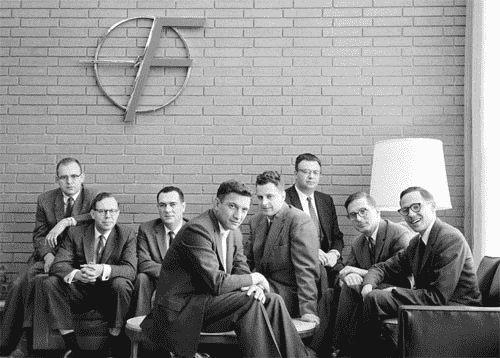
<?xml version="1.0" encoding="utf-8"?><feed xmlns="http://www.w3.org/2005/Atom" ><generator uri="https://jekyllrb.com/" version="3.10.0">Jekyll</generator><link href="https://kanwar.co/feed.xml" rel="self" type="application/atom+xml" /><link href="https://kanwar.co/" rel="alternate" type="text/html" /><updated>2025-11-26T23:34:55+00:00</updated><id>https://kanwar.co/feed.xml</id><title type="html">Kanwar</title><subtitle>Acid Test</subtitle><entry><title type="html">Something Ventured Notes</title><link href="https://kanwar.co/something-ventured-notes.html" rel="alternate" type="text/html" title="Something Ventured Notes" /><published>2019-09-30T03:39:00+00:00</published><updated>2019-09-30T03:39:00+00:00</updated><id>https://kanwar.co/something-ventured-notes</id><content type="html" xml:base="https://kanwar.co/something-ventured-notes.html"><![CDATA[<p>Before the Paypal mafia, there was the Fairchild Semiconductor mafia. <!--more--> From Fairchild, we have Silicon Valley: Intel, AMD, &amp; firms from Sequioa to KPCB.</p>

<p><img class="alignnone size-full wp-image-3475" src="/assets/posts/traitorous8.png" /></p>

<hr />
<p>Arthur Rock, one of the first VCs, was instrumental in seeding &amp; starting up Fairchild Semiconductor. From 1961-1968, he returned $100mm on $3mm invested.</p>

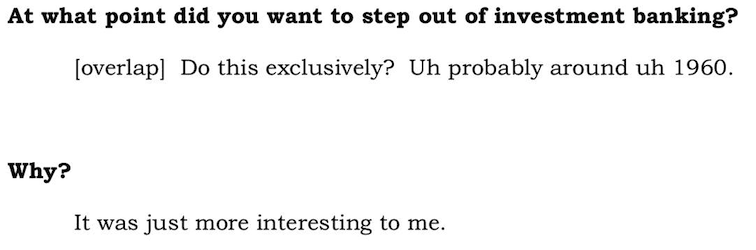
<p>Why he quit investment banking on Wall St for the barely named ‘venture capital’ in the 60s:</p>

<p><img class="alignnone size-full wp-image-3478" src="/assets/posts/Atwhatpointdidyouwanttostepoutofinvestmentbanking.png" alt="Atwhatpointdidyouwanttostepoutofinvestmentbanking.png" /></p>

<p>Rock:</p>
<blockquote>
  I wanted to do more of these venture capital type deals, but the money was all in the east. The scientists who had moved from the east to the west had all the ideas. I saw a great opportunity in bringing the East Coast money out backing these people on the West Coast.
</blockquote>
<hr />

<p>Tom Perkins on a philosophy I heard Josh Wolfe echo on InvestLikeTheBest:</p>

<p>“My idea in everything has always been to try to put the risk up front … and get rid of the risk as fast as you possibly can.”</p>

<p>Perkins helped make Genentech possible this way:</p>

<p><b>Tom Perkins</b>:</p>
<blockquote>
  We changed the business plan. I persuaded them to do it a different way, to subcontract the experiment to two different institutions.
</blockquote>

<p><b>Narrator</b>:</p>
<blockquote> 
  By subcontracting, Tom Perkins eliminated the need to buy equipment, build a lab and hire staff. The estimated $3M startup costs were reduced to $250,000. Kleiner Perkins put up the money and Genentech was in business.
</blockquote>

<hr />

<p>Sequioa founder Don Valentine on his approach when investing:</p>

<blockquote>

  <p>“These are very fragile companies with a lot of things missing and the approach we have always taken is, If we make this investment, is our rolodex strong enough to help these people?”</p>

</blockquote>

<p>Underscores that this is such a relationship driven business. Keith Rabois on monopolizing, packaging, recruiting talent echoes Valentine:</p>

<blockquote>
  What I'm often doing when I get involved in a company is helping founders <b>recognize where the misssing gaps</b> in their DNA vs. their vision are.
</blockquote>

<blockquote>
  And they may not have the network that has these superbly talented people. For example, if you're an early stage engineer and you need a finance guru, you may not know someone who's a CFO. I know lots of CFOs, I've interviewed tons of CFOs, I've worked with lots of CFOs. A critical success actor for a company is a CFO or general counsel. I have that network, I can help evaluate people and build that gap.
</blockquote>

<hr />

<p>When Don Valentine started investing, he’d already spent 13 years as an operator, including as an early executive at Fairchild and then National Semiconductor. Tom Perkins spent years as an engineer then manager at HP.</p>

<hr />

<p>Goldmine –– the transcripts at length: <a href="https://sirismm.si.edu/EADpdfs/NMAH.AC.1467.pdf">https://sirismm.si.edu/EADpdfs/NMAH.AC.1467.pdf</a></p>

<p>The Don Valentine ones (esp. part 3) are great for how tactical they are - how he approaches board meetings, etc.</p>]]></content><author><name></name></author><summary type="html"><![CDATA[Before the Paypal mafia, there was the Fairchild Semiconductor mafia.]]></summary></entry><entry><title type="html">The Joy Exercise</title><link href="https://kanwar.co/the-joy-exercise.html" rel="alternate" type="text/html" title="The Joy Exercise" /><published>2019-09-09T02:41:04+00:00</published><updated>2019-09-09T02:41:04+00:00</updated><id>https://kanwar.co/the-joy-exercise</id><content type="html" xml:base="https://kanwar.co/the-joy-exercise.html"><![CDATA[<p>You will never be:</p>

<p>Successful</p>

<p>Famous</p>

<p>Adulated</p>

<p>Extraordinary</p>

<p>Special</p>

<p>Recognized</p>

<p>Desired</p>

<p>Vindicated</p>

<p>Untouchable</p>

<p>A winner</p>

<p>What you think you need to be or wish you were</p>

<p>What then?</p>]]></content><author><name></name></author><summary type="html"><![CDATA[You will never be:]]></summary></entry><entry><title type="html">Siddhartha</title><link href="https://kanwar.co/siddhartha.html" rel="alternate" type="text/html" title="Siddhartha" /><published>2018-08-16T15:30:59+00:00</published><updated>2018-08-16T15:30:59+00:00</updated><id>https://kanwar.co/siddhartha</id><content type="html" xml:base="https://kanwar.co/siddhartha.html"><![CDATA[<p>Seven favourite passages from the book.
<!--more--></p>
<hr />

<p>“O Siddhartha,” he exclaimed, “will your father permit you to do that?”</p>

<p>Siddhartha looked over as if he was just waking up. Arrow-fast he read in Govinda’s soul, read the fear, read the submission.</p>

<p>“O Govinda,” he spoke quietly, “let’s not waste words. Tomorrow, at daybreak, I will begin the life of the Samanas. Speak no more of it.”</p>

<p> </p>

<hr />

<p>And Siddhartha said quietly, as if he was talking to himself: “What is meditation? What is leaving one’s body? What is fasting? What is holding one’s breath? It is fleeing from the self, it is a short escape of the agony of being a self, it is a short numbing of the senses against the pain and the pointlessness of life. The same escape, the same short numbing is what the driver of an ox-cart finds in the inn, drinking a few bowls of rice-wine or fermented coconut-milk. Then he won’t feel his self any more, then he won’t feel the pains of life any more, then he finds a short numbing of the senses.</p>

<p>[…]</p>

<p>And Siddhartha spoke with a smile: “I do not know, I’ve never been a drunkard. But that I, Siddhartha, find only a short numbing of the senses in my exercises and meditations and that I am just as far removed from wisdom, from salvation, as a child in the mother’s womb, this I know, oh Govinda, this I know.”</p>

<p> </p>

<hr />

<p>“This is why I am continuing my travels—not to seek other, better teachings, for I know there are none, but to depart from all teachings and all teachers and to reach my goal by myself or to die.”</p>

<p> </p>

<hr />

<p>“Oh,” he thought, taking a deep breath, “now I would not let Siddhartha escape from me again! … I do not want to kill and dissect myself any longer, to find a secret behind the ruins.</p>

<p>Neither Yoga-Veda shall teach me any more, nor Atharva-Veda, nor the ascetics, nor any kind of teachings. I want to learn from myself, want to be my student, want to get to know myself, the secret of Siddhartha.”</p>

<p> </p>

<hr />

<p>“When you throw a rock into the water, it will speed on the fastest course to the bottom of the water. This is how it is when Siddhartha has a goal, a resolution. Siddhartha does nothing, he waits, he thinks, he fasts, but he passes through the things of the world like a rock through water, without doing anything, without stirring; he is drawn, he lets himself fall. <strong>His goal attracts him, because he doesn’t </strong><strong>let anything enter his soul which might oppose the goal.</strong>”</p>

<p> </p>

<hr />

<p>He had heard a voice, a voice in his own heart, which had commanded him to seek rest under this tree, and he had neither preferred self-castigation, offerings, ablutions, nor prayer, neither food nor drink, neither sleep nor dream, he had obeyed the voice. To obey like this, not to an external command, only to the voice, to be ready like this, this was good, this was necessary, nothing else was necessary.</p>

<p> </p>

<hr />

<p>“I can think. I can wait. I can fast.”</p>

<p> </p>]]></content><author><name></name></author><category term="book_notes" /><summary type="html"><![CDATA[Seven favourite passages from the book.]]></summary></entry><entry><title type="html">Flight of the Garuda</title><link href="https://kanwar.co/flight-of-the-garuda.html" rel="alternate" type="text/html" title="Flight of the Garuda" /><published>2018-08-05T18:36:52+00:00</published><updated>2018-08-05T18:36:52+00:00</updated><id>https://kanwar.co/flight-of-the-garuda</id><content type="html" xml:base="https://kanwar.co/flight-of-the-garuda.html"><![CDATA[<p>Passages I noted from Keith Dowman’s translation of the book.</p>

<p>“Thinking of the key confirms the prison.”</p>

<!--more-->
<p>“What grief lies in distinguishing effort from attainment!”</p>

<hr />

<p>“The arid assertions and metaphors of others — statements such as “Mind is emptiness!” — are worse than useless. <b>Until you know the answer yourself, such statements tend to bring doubt and hesitation</b> to the mind…”</p>

<p>“Until we recognize vision as presence — and only that — in whatever way we try to cultivate the mind through meditation practice we will be confined to a contrived view and to meditation structured by the intellect.”</p>

<p>“Now, although the original face of mind has been revealed, and we are convinced that buddhahood is the primal awareness of pure being, if we lack confidence in the process of release, the mere meditation of a resting, quiescent mind will confine us to a subtly deviant existence in the higher realms of the gods. Such meditation cannot dominate the exigencies of lust and anger; it cannot stop the flow of karmically conditioned impulses; and it cannot turn our conviction into confidence. Thus the process of release is all-important.”</p>

<hr />

<p>“Appearances, on the other hand, do not obstruct or fill emptiness: although they are manifest, their nature is originally empty.”</p>

<hr />

<p>If we invest our confidence in the mere concentrated absorption of a quiescent mind, a meditation technique that lacks the dynamic of release, we stray into high trance states. <strong>Our belief in the sufficiency of recognizing quiescence and movement as such is not different from ordinary confused thinking</strong>, and although our minds are impregnated with intellectual concepts like emptiness and pure being, <strong>when we are confronted by adverse circumstances, the inadequacy of our remedy is exposed and our innate capability is found wanting.</strong> So, “Without this vital process of release, meditation is delusion.”</p>

<p>Instead of rejecting emotions, consider what they are awareness of. Discover first where they come from, then where it is now, and finally where it goes.</p>

<hr />

<p>“Look at the form of a beautiful statue or a great painting and observe the mind that thinks How beautiful! Look at the form of a hideous frog and observe the mind that thinks How repulsive! When looking at the mind, emptiness is the one taste in both perceptions.”</p>

<hr />

<p>“The greater the passion and the greater intensity of discursive thought the greater the dharmakaya.”</p>

<hr />

<p>“No matter how large or violent the rolling wave, it cannot escape the ocean for a moment. In the same way, mind, passive or active, cannot escape total presence and emptiness to the slightest degree.”</p>

<hr />

<p>“After you have fully intuited and established the original existential condition of the Dzogchen vision, you must utterly sever the ties of attachment and aversion to your family and homeland.</p>

<p>Go alone to the forest or to a mountain hermitage. Abandon all physical work and dwell at ease; cease all verbal expression and remain in silence; transcend all objects of thought and let your mind merge with space. In this state, relax, without attempting to change anything, and without diffusion or fixation of your consciousness.</p>

<p>When the mind is free of all ambition and all belief supports, that is Dzogchen vision. Abide in a state of nonmeditation. Realize Dzogchen’s goal of nonattainment.</p>

<p>Furthermore, when you are composed in equanimity, living the vision, do not become entangled in any web of judgemental thought by saying to yourself Now I’ve arrived at a state of total presence! or Now I’m caught in manic depression! No, stay wakeful in the continuum of reality without any notion of present or future attainment, flexible and responsive in unobstructed freedom.</p>

<p>You cannot perceive nonconceptual truth with your structured intellect, and you cannot reach the place of nonaction through temporal activity. If you want to attain the nonceptual goal of nonaction, rest in naked total presence free of dualistic grasping.”</p>

<hr />

<p>“The matrix of vision is observation of emptiness and radiance without clinging to it. The matrix of meditation is maintenance of reflexive release without clinging to it. The matrix of action is relaxation with a free and easy response to the six sense fields. The matrix of the goal is collapse of all expectations and apprehension.”</p>

<hr />

<p>“When we are free of all inhibition and indulgence, we perform sovereign activity. When mind is free of hope and fear, we have attained the sovereign goal.”</p>

<p>“As there is nothing to see, abandon all fixed ideas, all preconceived notions, and all parameters of vision. As there is nothing upon which to meditate, let be whatever arises adventitiously. As there is no particular way to behave, give up evaluation, judgement, and criticism. As there is nothing to attain, forsake all expectation of results.”</p>

<hr />

<p>“Its essence is emptiness, so abandon self-denial and self-improvement.”</p>

<hr />

<p>“The yogin’s perception is like the flight path of a bird in the sky. The bird’s flight path vanishes without trace: each previous perception vanishes without repercussion –– do not attempt to prolong a perception by pursuing it and clinging to it. The bird’s future flight path is as yet nonexistent: do not anticipate the next perception. The present bird print in the sky is colorless and shapeless: the present perception has an ordinary, unremarkable form –– leave it alone and refrain from contaminating it or modifying it by applying antidotes.</p>

<p>Just as phenomena arise let them be and do not cling!”</p>

<hr />

<p>“Conduct is a performance of magical illusion, innocent of any distinction between giving and taking, abstinence and indulgence, for intense activity is purposeless.”</p>

<hr />

<p>“Do not dress up total presence, which is naked clarity itself, in the clothes of elaborate intellectual analysis.”</p>

<hr />

<p>This nonaction may be crucial, but it is not understood by some. Everything is already done, but they say, “I must work hard!” Everything has been liberated from the beginning, but they say, “I want to be free!” Everything is at rest from the beginning, but they say, “I want peace of mind!” The mind is in meditation from the beginning, but they say, “I must meditate!” The vision exists from the beginning, but they say, “I must see it!” The goal is attained from the first, but they say, “I must reach it!”</p>

<p>People who trust in an analytical view are learned, but they know only the taste of dead words and divisive concepts. They claim understanding, but it is an idle boast. They meditate, but their meditation consists of mental structures. They examine the mind, but cling to duality. They are successful, but it is all in samsara.</p>

<p>It is certain that the intellectual with an analytical view of reality has no connection with the Heart Essence of the Great Perfection, the Dzogchen Nyingtig.</p>

<hr />

<p>“However,” you may ask, “although at first I may rest free and easy when perceiving external, delusive objects of mind, later will I not again regress into bewilderment?”</p>

<p>The answer to your question is that ordinary individuals attached to their ego will certainly go astray. But as for the yogin who understands all appearances as causeless and baseless and who refrains from attempting to change himself or phenomena, rejecting some things and cultivating others, he will not err because he is naturally composed in detached equanimity.</p>]]></content><author><name></name></author><category term="book_notes" /><summary type="html"><![CDATA[Passages I noted from Keith Dowman’s translation of the book. “Thinking of the key confirms the prison.”]]></summary></entry><entry><title type="html">Church</title><link href="https://kanwar.co/church.html" rel="alternate" type="text/html" title="Church" /><published>2018-05-15T05:31:45+00:00</published><updated>2018-05-15T05:31:45+00:00</updated><id>https://kanwar.co/church</id><content type="html" xml:base="https://kanwar.co/church.html"><![CDATA[<p>Last year I had tea with a friend’s father.</p>

<p>He was born in the Himalayas, lived through a civil war in Nigeria, and eventually built a successful career in Canada.</p>

<p>I met him at the offices of the firm he founded and built. We spoke about his business, but ended up talking about life, spirituality, and the lessons he’d learned.</p>

<p>When he was growing up, his own father sent him to church every week without fail. This is what his father - my friend’s grandfather - told him:</p>

<p>“I don’t care about the religious stuff. I just think it’s good for you to spend an hour where you’re not thinking about yourself.”</p>]]></content><author><name></name></author><summary type="html"><![CDATA[Last year I had tea with a friend’s father.]]></summary></entry><entry><title type="html">Anything you want</title><link href="https://kanwar.co/anything-you-want.html" rel="alternate" type="text/html" title="Anything you want" /><published>2018-05-03T17:53:53+00:00</published><updated>2018-05-03T17:53:53+00:00</updated><id>https://kanwar.co/anything-you-want</id><content type="html" xml:base="https://kanwar.co/anything-you-want.html"><![CDATA[<p>Naval: “You can get to whatever you want to. You just have to care about it badly enough.”
<!--more--></p>

<p>“When I went to college, my first year there I had three jobs, and it was delivering newspapers and washing dishes and those kinds of jobs in the school cafeteria.</p>

<p>And if you’re the 17-year-old kid and you’re working in the cafeteria and you’re washing dishes and all the other kids are out there having fun and eating, it sticks with you. It makes an impression.</p>

<p>And I said, “Well, this is terrible. I don’t want to do this.”</p>

<p>At the time, I was majoring in English and history. And I was like, “Okay, if I keep doing that, I’m going to continue doing this and it’s not the way to go.”</p>

<p>So I actually went and smooth talked my way into tutoring an advanced computer science class when I was completely unqualified. I didn’t even know the subject matter at hand. So then what I had to do was I had to learn the material well enough the night before that I could be at tutoring level the next morning in the class.</p>

<p>And that was a seminal point, because it showed me a few things. One is you can get to whatever you want to get to. You just have to care about it badly enough.”</p>

<p> </p>

<p>From his interview w Mixergy.</p>

<p> </p>

<ul>
<li>very short feedback loop on learning (teaching it to that class)</li>
<li>learning by explaining to others</li>
<li>highly incentivized to learn (external accountability, motivation to avoid, motivation to gain)</li>
<li>pre-commited to system w/accountability, proved to himself it was possible in doing so</li>
</ul>]]></content><author><name></name></author><summary type="html"><![CDATA[Naval: “You can get to whatever you want to. You just have to care about it badly enough.”]]></summary></entry><entry><title type="html">Hagakure</title><link href="https://kanwar.co/hagakure.html" rel="alternate" type="text/html" title="Hagakure" /><published>2018-04-15T07:52:01+00:00</published><updated>2018-04-15T07:52:01+00:00</updated><id>https://kanwar.co/hagakure</id><content type="html" xml:base="https://kanwar.co/hagakure.html"><![CDATA[<p>Three favorite excerpts from the book.</p>

<p>I.</p>

<p>Everyone lets the present moment slip by, then looks for it as though he thought it were somewhere else.
<!--more--></p>

<p>II.</p>

<p>When meeting calamities or difficult situations, it is not enough to simply say that one is not at all flustered. When meeting difficult situations, one should dash forward bravely and with joy. It is the crowning of a single barrier and is like the saying, “The more the water, the higher the boat”.</p>

<p>III.</p>

<p>We all want to live. And in large part we make our logic according to what we like.</p>

<p>But not having attained our aim and continuing to live is cowardice.</p>

<p>This is a thin dangerous line. To die without gaining one’s aim is a dog’s death and fanaticism.</p>

<p>But there is no shame in this.</p>

<p>This is the substance of the Way of the Samurai.</p>

<p>If by setting one’s heart right every morning and evening, one is able to live as though his body were already dead, he gains freedom in the Way.</p>]]></content><author><name></name></author><category term="book_notes" /><summary type="html"><![CDATA[Three favorite excerpts from the book. I. Everyone lets the present moment slip by, then looks for it as though he thought it were somewhere else.]]></summary></entry><entry><title type="html">Freedom from the known</title><link href="https://kanwar.co/freedom-from-the-known.html" rel="alternate" type="text/html" title="Freedom from the known" /><published>2018-03-10T21:51:20+00:00</published><updated>2018-03-10T21:51:20+00:00</updated><id>https://kanwar.co/freedom-from-the-known</id><content type="html" xml:base="https://kanwar.co/freedom-from-the-known.html"><![CDATA[<p>Excerpts I noted from Krishnamurti in <em>Freedom from the Known</em>:</p>

<p>“The primary cause of disorder in ourselves is the seeking of reality promised by another […]”</p>

<!--more-->

<p>“So if we completely reject, <strong>not intellectually but actually,</strong> all so-called spiritual authority, all ceremonies, rituals and dogmas […].”</p>

<hr />

<p>“You have now started by denying something absolutely false – the traditional approach – but if you deny it as a reaction you will have created another pattern in which you will be trapped; if you tell yourself intellectually that this denial is a very good idea but do nothing about it, you cannot go any further. If you deny it, however, because you understand the stupidity and immaturity of it, if you reject it with tremendous intelligence, a,<strong>because you are free and not frightened</strong>, you will create a great disturbance in yourself and around you but you will step out of the trap of respectability. Then you will find that you are no longer seeking. That is the first thing to learn – not to seek. When you seek you are really only window-shopping.”</p>

<hr />

<p>“So you see that you cannot depend upon anybody. There is no guide, no teacher, no authority. There is only you – your relationship with others and with the world – there is nothing else.”</p>

<hr />

<p>“Or else you may say, ‘I see the necessity for a fundamental inward change in myself but how am I to bring it about? Please show me the way, help me towards it.’ If you say that, then what you are concerned with is not change itself; you are not really interested in a fundamental revolution: you are merely searching for a method, a system, to bring about change.”</p>

<hr />

<p>“Let us state it again clearly: I see that I must change completely from the roots of my being; I can no longer depend on any tradition because tradition has brought about this colossal laziness, acceptance and obedience; I cannot possibly look to another to help me to change, not to any teacher, any God, any belief, any system, any outside pressure or influence. What then takes place?”</p>

<hr />

<p>“If I were foolish enough to give you a system and if you were foolish enough to follow it, you would merely be copying, imitating, conforming, accepting, and when you do that you have set up in yourself the authority of another and hence there is conflict between you and that authority. You feel you must do such and such a thing because you have been told to do it and yet you are incapable of doing it. You have your own particular inclinations, tendencies and pressures which conflict with the system you think you ought to follow and therefore there is a contradiction. So you will lead a double life between the ideology of the system and the actuality of your daily existence. <strong>In trying to conform to the ideology, you suppress yourself – whereas what is actually true is not the ideology but what you are.</strong> If you try to study yourself according to another you will always remain a secondhand human being.”</p>

<hr />

<p>“<strong>Order imposed from without must always breed disorder.</strong> You may see the truth of this intellectually but can you actually apply it so that your mind no longer projects any authority, the authority of a book, a teacher, a wife or husband, a parent, a friend or of society? Because we have always functioned within the pattern of a formula, the formula becomes the ideology and the authority; but the moment you really see that the question, ‘How can I change?’ sets up a new authority, you have finished with authority for ever.”</p>

<hr />

<p>“What we are now going to do, therefore, is to learn about ourselves, not according to me or to some analyst or philosopher – because <strong>if we learn about ourselves according to someone else, we learn about them, not ourselves</strong> – we are going to learn what we actually are.”</p>

<hr />

<p>“Having realised that we can depend on no outside authority in bringing about a total revolution within the structure of our own psyche, there is the immensely greater difficulty of rejecting our own inward authority, the authority of our own particular little experiences and accumulated opinions, knowledge, ideas and ideals. <strong>You had an experience yesterday which taught you something and what it taught you becomes a new authority – and that authority of yesterday is as destructive as the authority of a thousand years. To understand ourselves needs no authority either of yesterday or of a thousand years</strong> because we are living things, always moving, flowing, never resting. When we look at ourselves with the dead authority of yesterday we will fail to understand the living movement and the beauty and quality of that movement.</p>

<hr />

<p>“To be free of all authority, of your own and that of another, is to die to everything of yesterday, so that your mind is always fresh, always young, innocent, full of vigour and passion. It is only in that state that one learns and observes. And for this a great deal of awareness is required, actual awareness of what is going on inside yourself, without correcting it or telling it what it should or should not be, because the moment you correct it you have established another authority, a censor.”</p>

<p> </p>]]></content><author><name></name></author><category term="book_notes" /><summary type="html"><![CDATA[Excerpts I noted from Krishnamurti in Freedom from the Known: “The primary cause of disorder in ourselves is the seeking of reality promised by another […]”]]></summary></entry><entry><title type="html">Breath</title><link href="https://kanwar.co/breath.html" rel="alternate" type="text/html" title="Breath" /><published>2018-02-19T21:12:08+00:00</published><updated>2018-02-19T21:12:08+00:00</updated><id>https://kanwar.co/breath</id><content type="html" xml:base="https://kanwar.co/breath.html"><![CDATA[<p>Let the breath come and go as it pleases.</p>

<p>On the in breath, there is no grasping, no pulling in, no holding on to.</p>

<p>On the out breath, there is no pushing away, no aversion, no waiting for its conclusion.</p>

<p>It makes a home of wherever it goes.</p>

<p>And in observing it, in letting it be, we learn to do the same.</p>

<p>This is love.</p>]]></content><author><name></name></author><summary type="html"><![CDATA[Let the breath come and go as it pleases.]]></summary></entry><entry><title type="html">Perform nothing</title><link href="https://kanwar.co/perform-nothing.html" rel="alternate" type="text/html" title="Perform nothing" /><published>2018-02-01T18:55:04+00:00</published><updated>2018-02-01T18:55:04+00:00</updated><id>https://kanwar.co/perform-nothing</id><content type="html" xml:base="https://kanwar.co/perform-nothing.html"><![CDATA[<p>Rainn Wilson and Kevin Hart make the choice that defines them as artists and performers: they stop pretending to be what they think the audience wants to see. <!--more--> I started doing improv a few months ago, and these 100% resonate.</p>

<p>From Rainn Wilson, a conversation with his acting instructor:</p>

<blockquote>

  <p>“Ron Van Lieu looked at me and said, “Rainn, I believe that you’re very talented. Why do you keep getting in your own way?” […]</p>

</blockquote>

<blockquote>

  <p>We began to discuss what was really going on with me and I realized that underneath all my tension and bad acting was FEAR. Fear of rejection, of abandonment, of not being liked. I truly thought that if the audience was able to see the real me, they’d get bored and hate what they saw. In my acting I then amped everything up to try to “be more interesting.” This of course only made me look like a broken acting robot, filled with gestures and tension that had nothing to do with the character I was playing or the scene I was in.</p>

</blockquote>

<blockquote>

  <p>We decided to let all that go. <b>I made a commitment to “dare to be boring.”</b> To just listen while acting. To simply breathe. To BE the character and see the world through the character’s eyes, without amplifying my performance in any way, shape, or form.</p>

</blockquote>

<blockquote>

  <p>The idea of working in this manner was absolutely terrifying to me.</p>

</blockquote>

<blockquote>

  <p>The next scene I performed was from Long Day’s Journey into Night by Eugene O’Neill. <b>I truly dared to be boring. I just sat there and listened to my scene partner, without self-consciousness, worry, or any forced indication of listening.</b></p>

  <p>To me, I felt naked, bereft, unadorned, afraid. But I could tell I was onto something. Surprise, surprise, I was far more interesting to watch when I didn’t try to be interesting! Simply being and listening can be riveting if the internal life is fully fleshed out. […]</p>

</blockquote>

<blockquote>

  <p>To me <strong>the key to acting is listening.</strong> You can’t believe how many actors “fake listen” when onstage or on camera. We all certainly know what it’s like when someone is not truly listening to us in everyday conversation, how strained and hollow the conversation can feel. A great deal of the time, when we’re watching actors and not responding to their performances, it’s because of this specific issue.</p>

</blockquote>

<blockquote>

  <p>Most of my favorite acting moments of all time are not showy moments of bravado but simple ones, when the actor’s body, mind, and heart are filled with truth and a deep reservoir of emotion.”</p>

</blockquote>

<p>In trying to “be more interesting,” he’s identifying with the desire to achieve some external outcome, that is, some reaction from the audience, instead of portraying - being - his character. He’s watching the audience instead of paying full attention to what’s unfolding in the scene – being only in the scene –, which he identifies, saying “the key of acting is listening.”</p>

<hr />

<p>From Kevin Hart, on changing his stage name from Lil’ Kev the Bastard to using his real name:</p>

<blockquote>

  <p>“After the set, I asked Keith, “What did you think?” I was certain I’d impressed him with my young, raw talent, and waited for the praise to roll in.</p>

</blockquote>

<blockquote>

  <p>“It was awful.”</p>

</blockquote>

<blockquote>

  <p>“Awful?” In all this time, no one had said anything that direct and harsh to me—especially not an older, established comedian.</p>

</blockquote>

<blockquote>

  <p>“You’re not talking about shit,” he continued. “I’m not getting to know who you are.”</p>

</blockquote>

<blockquote>

  <p>“What do you mean? You just saw me. Everyone was laughing.”</p>

</blockquote>

<blockquote>

  <p>“So what? People will laugh at anything. You’re doing ‘black crowd tricks,’ son. Comedy is about experimentation. You’re rehashing corny bits that have already been done and will always work. It’s TV dinner comedy: prepackaged.” His words hurt, but I tried not to show it. “Stop catering to the audience and start working on being a comedian, young fella.”</p>

</blockquote>

<blockquote>

  <p>I tried to respond, but I couldn’t get any words out. I’d just beat out all the other comedians in Philly. I had to at least have something going for me.</p>

</blockquote>

<blockquote>

  <p>“Now, I definitely saw some pizzazz,” Keith went on. “I saw a solid stage presence and a lot of energy. But none of that set was about you. So it means nothing.”</p>

</blockquote>

<blockquote>

  <p>There’s only so much abuse a person can take. Who was this guy to come out of nowhere and tell me to change my whole act?</p>

</blockquote>

<blockquote>

  <p>“You tell ’em your real name.” He slapped me hard on the back. “It’ll take you further and it’ll sharpen you up. Stay and watch my set.”</p>

</blockquote>

<blockquote>

  <p>I stuck around and saw Keith perform. His entire routine was about him: his life, his point of view, his family. He told jokes about his mom and his brother, sharing insights about them that were so specific, they had to be true. <strong>Unlike me, he was very relaxed on stage and wasn’t afraid to take long pauses and let things settle. He didn’t seem to be putting on a persona so much as sharing his own personality at its best. He was right: Compared to him, I looked like an amateur who was trying too hard.</strong></p>

</blockquote>

<blockquote>

  <p>I decided that night to try letting go of my comedy name. When there are no consequences to taking someone’s advice, then there’s no reason not to test it out and see if it works.”</p>

</blockquote>

<p>This requires courage. We hide behind performance, following checklists and repeating existing routines.</p>

<blockquote>

  <p>[Keith:] “However, you want to have a relationship with the audience, and the name you were born with is going to have more depth and authenticity than a character you made up.”</p>

</blockquote>

<blockquote>

  <p>“Yeah,” I sighed. <strong>On an intuitive level, I knew that he was right. But I didn’t want to start all over as Kevin Hart and throw away the work I’d done so far.</strong></p>

</blockquote>

<blockquote>

  <p>“I can see the doubt in your eyes.” Keith grew more impassioned, leaning in a little too close. “Stop being a dummy. Your job as a person with talent is to make yourself interesting after the audience hears your name.<sup>1</sup> Define the person who was just introduced.”</p>

</blockquote>

<blockquote>

  <p>“How do you do that?”</p>

</blockquote>

<blockquote>

  <p>“It’s simple, stupid. You be yourself. When they say Kevin Hart, your first words should be ‘Hey, what’s going on? My name is Kevin Hart. I’m happy to be here.’ ”</p>

</blockquote>

<blockquote>

  <p>It felt like he’d just told me to pull down my pants and take a crap on stage. In fact, taking an on-stage shit would have made more sense to me. At least that was interesting and memorable. Starting out by greeting the audience like I was at a job interview made absolutely no sense. But I was willing to try it again.”</p>

</blockquote>

<p>I loved that reframe (“As a person with talent, your job …”).</p>]]></content><author><name></name></author><summary type="html"><![CDATA[Rainn Wilson and Kevin Hart make the choice that defines them as artists and performers: they stop pretending to be what they think the audience wants to see.]]></summary></entry></feed>